
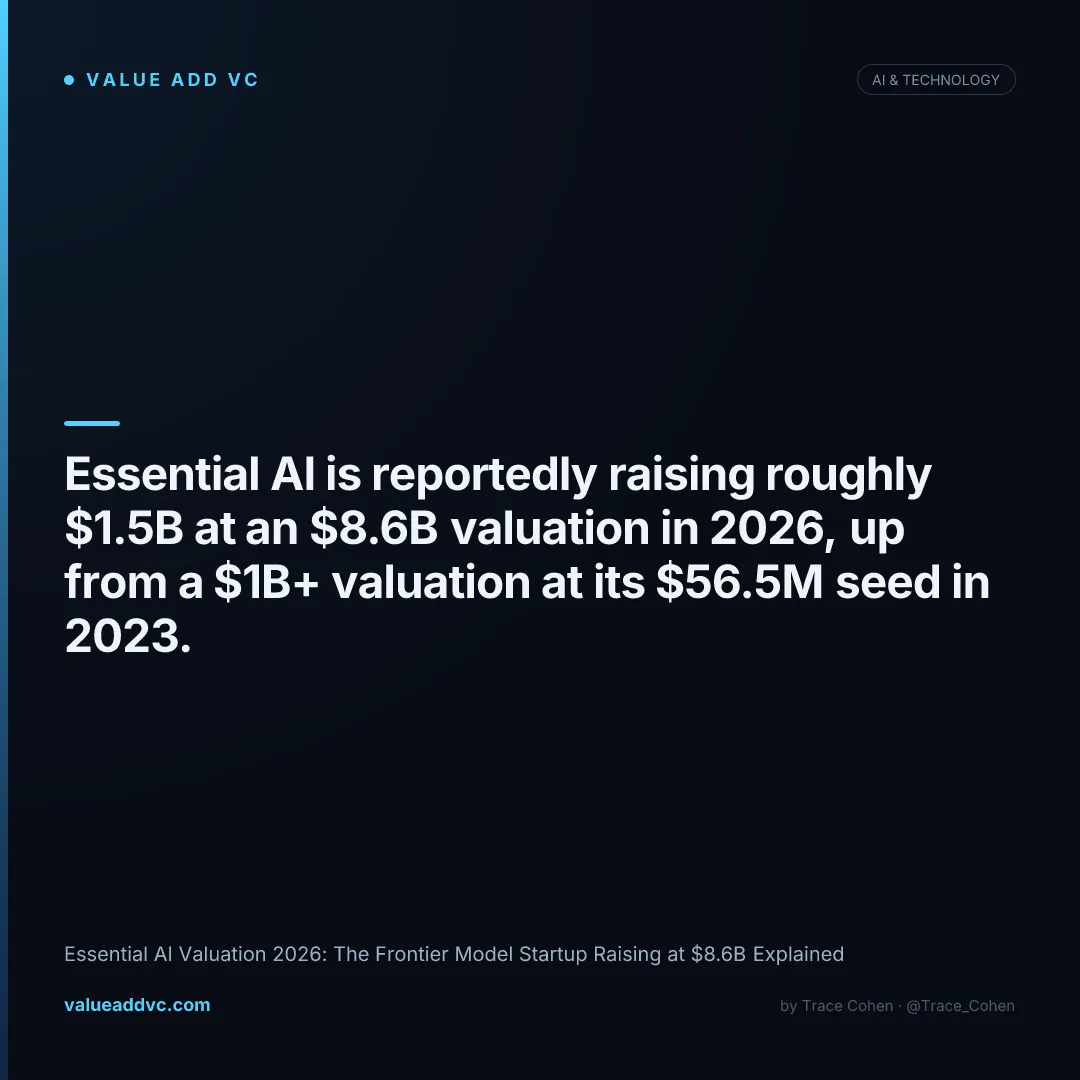
Correction — October 6, 2026
Earlier versions of this article said Essential AI was raising about $1.5 billion at an $8.6 billion valuation, that its $56.5 million 2023 round was a seed carrying a valuation above $1 billion, that it raised a $175 million Series B in August 2025, and that Thursday Ventures was an investor. We could not find a source for any of those claims and have removed them. Essential AI's disclosed financing is an $8.3 million seed and a $56.5 million Series A (December 2023), per its Business Wire announcement; no valuation was published.
Essential AI has disclosed about $65M in funding — an $8.3M seed and a $56.5M Series A in December 2023 — and never published a valuation. In June 2026, Axios reported that Nvidia acqui-hired its team, including CEO Ashish Vaswani.
Essential AI is the kind of company that breaks every spreadsheet a traditional investor brings to a meeting. There is no ARR to multiply, no net revenue retention to model, no payback period to compute. What there was: two of the eight people who co-wrote the paper that created modern AI, strategic checks from NVIDIA, AMD, and Google, and a thesis that a frontier-class model could come from a lean team rather than a 1,000-person lab.
Essential AI Valuation: What Is Actually on the Record
Essential AI has not published a valuation for any of its rounds. The company was founded in 2023 by Ashish Vaswani and Niki Parmar — two co-authors of "Attention Is All You Need" — and announced a $56.5M Series A in December 2023 led by March Capital, with AMD, Franklin Venture Partners, Google, KB Investment, NVIDIA, and Thrive Capital participating. That followed an $8.3M seed led by Thrive Capital, for what the company called "a total of nearly $65 million in funding to date," per its Business Wire announcement. There is no public record of a later round, including a Series B.
Earlier versions of this article reported a roughly $1.5B raise at an $8.6B valuation. We could not trace that figure to a company announcement or a named press report, and it is hard to square with what did happen: on June 23, 2026, Axios reported that "Nvidia also acqui-hired the team behind Essential AI, including AI researcher Ashish Vaswani," describing the move as "more along the lines of the expected consolidation of startups." Track how other frontier labs are priced on the AI Valuations dashboard.
Essential AI Funding History and Cap Table
The Essential AI cap table explains why the company drew so much attention for a $56.5M round. Alongside lead investor March Capital, the Series A brought in strategics who sell the picks and shovels of AI: NVIDIA and AMD (chips) and Google (cloud and models). Those investors don't price on multiples; they price on strategic optionality and on keeping a seat close to frontier research.
| Round | Year | Amount | Valuation | Lead / Notable Investors |
|---|---|---|---|---|
| Seed | 2023 | $8.3M | Not disclosed | Thrive Capital (lead); Conviction, Elad Gil, Brad Gerstner, Amjad Masad, others |
| Series A | Dec 2023 | $56.5M | Not disclosed | March Capital (lead); AMD, Franklin Venture Partners, Google, KB Investment, NVIDIA, Thrive Capital |
| Total disclosed | 2023 | ~$65M | — | "Nearly $65 million in funding to date" (company) |
| Nvidia acqui-hire (reported) | Jun 2026 | Not reported | — | Team, including Ashish Vaswani, per Axios |
| Founder count | 2023 | 2 | — | Vaswani + Parmar (ex-Google Brain, ex-Adept) |
| Transformer co-authors | 2017 | 2 of 8 | — | “Attention Is All You Need” |
Sources: Essential AI's Series A announcement (Business Wire, December 12, 2023) and Axios (June 23, 2026). Essential AI did not publish a valuation for either round.
What Essential AI Actually Builds
Essential AI launched pitching enterprise AI: "full-stack AI products that quickly learn to increase productivity by automating time-consuming and monotonous workflows," in the words of its 2023 Series A announcement. By mid-2025 the emphasis had shifted toward open research. Vaswani told the Economic Times in June 2025 that the team was building "an open science or open-source frontier model that everybody can control" and wanted to be "the DeepSeek in the West." Its public research output includes Essential-Web v1.0, a 24-trillion-token organized web dataset released in June 2025.
Frontier model research
Competing on capability with far larger labs requires data and compute efficiency, not just scale
Enterprise automation
The original 2023 pitch: products that automate repetitive knowledge-work workflows
Open data releases
Essential-Web v1.0 (24 trillion tokens, June 2025) built research credibility and recruiting gravity
Strategic investors
NVIDIA, AMD, and Google all participated in the December 2023 Series A
How Essential AI Compares to Other Frontier Labs
Every other lab below has a disclosed or reported valuation; Essential AI does not, which is the clearest sign of how differently its story played out. The comparison also shows the capital gap: Anthropic's May 2026 Series H alone ($65B) was roughly 1,000 times Essential AI's entire disclosed funding, and OpenAI's March 2026 round carried $122B in committed capital.
| Lab | Latest Valuation | Basis |
|---|---|---|
| Anthropic | $965B | $65B Series H, May 2026 |
| OpenAI | $852B | $122B round, March 2026 |
| Mistral | €21B+ | €3B round, September 2026 |
| Cohere (with Aleph Alpha) | ~$20B | Merger deal, April 2026 (per the FT) |
| Thinking Machines Lab | $12B | $2B seed, July 2025; reported in talks at $40B, Sep 2026 |
| Sakana AI | $2.65B | $135M Series B, November 2025 |
| Essential AI | Not disclosed | $56.5M Series A, Dec 2023; team acqui-hired by Nvidia, June 2026 (per Axios) |
Sources: Anthropic; The Register (Mistral and OpenAI); TechCrunch (Cohere, citing the FT; the deal had yet to close when reported); TechCrunch on Thinking Machines and Sakana AI. Private-company valuations are not audited.
The Other Transformer Co-Authors' Startups, and How They're Valued
A natural comparison set for Essential AI is the other companies founded by "Attention Is All You Need" co-authors — all eight authors left Google within a few years of publishing the paper. Aidan Gomez co-founded Cohere in 2019; its April 2026 merger with Aleph Alpha was set to value the combined company at $20 billion, the FT reported. Noam Shazeer co-founded Character.AI in 2021, and Google later paid more than $2 billion to acqui-hire him and part of the Character.AI team, according to Axios. Llion Jones co-founded Sakana AI in Tokyo in 2023 — the same year Essential AI was founded — and Sakana raised a $135 million Series B in November 2025 at a $2.65 billion valuation, up from $1.5 billion a year earlier.
Essential AI took a different path. After its December 2023 Series A it disclosed no further funding, and in June 2026 Axios reported that Nvidia acqui-hired the team. Cohere and Sakana went on to raise or merge at multi-billion-dollar valuations; Essential AI's pedigree drew strategic capital early, but its reported endgame was a talent deal rather than a growth round.
What Essential AI's Path Says About Frontier-Lab Pricing
With no published valuation, there is no Essential AI price to defend or attack. The more useful question is what its path shows about how frontier labs get priced. Founder pedigree reliably opens the door to a well-subscribed early round with strategic investors. It does not, on its own, secure the tens of billions of dollars that frontier training now consumes, and labs that cannot raise at that scale tend to end up as partners, licensors, or acqui-hires of the companies that can.
What the Pedigree Bought
- ✓ Two Transformer co-authors — rare architectural pedigree
- ✓ Series A participation from NVIDIA, AMD, and Google
- ✓ Open research releases such as Essential-Web v1.0
- ✓ A lean team that drew a reported Nvidia acqui-hire
What It Ran Into
- ✕ About $65M disclosed funding vs. tens of billions at the leading labs
- ✕ No disclosed revenue or commercial product scale
- ✕ No disclosed round after December 2023
- ✕ Second-tier labs squeezed between frontier labs and open models
Essential AI never published a valuation — its disclosed record is about $65M raised.
The $8.6B figure once reported here has no traceable source; the reported 2026 outcome is an Nvidia acqui-hire of the team.
Track frontier-lab valuations and AI funding trends on the AI Valuations Dashboard at Value Add VC. Originally published in the Trace Cohen newsletter.
Latest from the Pulse
Get VC data most people never see
— free to subscribe
Trace's notes on venture, AI and startups, a few times a week. Join 5,000+ subscribers. No spam.
No spam, unsubscribe anytime. Sent via Substack · Privacy · or subscribe on Substack ↗