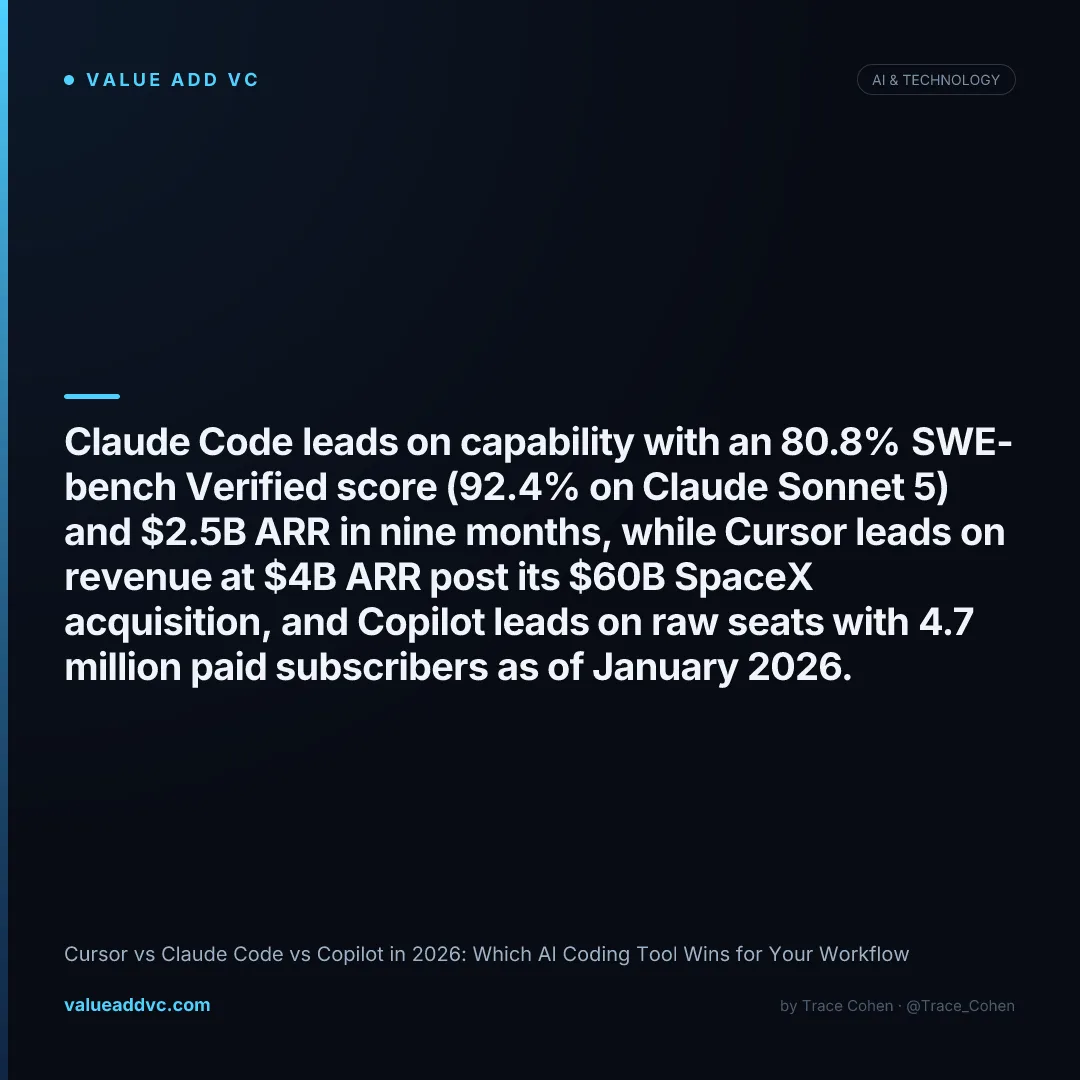
Claude Code has the best benchmark scores, Cursor has the most revenue at $4 billion ARR, and GitHub Copilot has the most paid users at 4.7 million. That's the short answer to who's winning. The longer answer is that none of the three actually compete head-to-head anymore, because most developers now run at least two of them at once.
I watch this category closely because half my portfolio companies now write a meaningful share of their code through one of these three tools, and the competitive picture shifted hard this month: SpaceX closed a $60 billion all-stock acquisition of Cursor's parent company, Anysphere, on August 14, 2026 — six days before this post — folding the most-funded AI coding startup into a new SpaceXAI division. That changes how founders should think about Cursor vs Claude Code vs Copilot heading into the back half of 2026.
Cursor vs Claude Code vs Copilot in 2026: the side-by-side
Cursor vs Claude Code vs Copilot comes down to three different products solving overlapping but distinct problems: a standalone AI-native editor, a terminal-based autonomous coding agent, and an in-IDE completion assistant now billed by usage. Here's how the three stack up on the attributes that actually decide which one you pay for.
| Attribute | Cursor | Claude Code | GitHub Copilot |
|---|---|---|---|
| Owner | SpaceX (since Aug 14, 2026) | Anthropic | Microsoft / GitHub |
| Entry price | $20/mo Pro | $0 free tier, $20/mo Pro | $0 free tier, $10/mo Pro |
| Top individual tier | Usage-based overage above Pro | $200/mo Max 20x | $100/mo Max |
| Team/Enterprise price | Custom, seat-based | $25-$125/seat/mo | $19-$39/user/mo |
| SWE-bench Verified score | 48% (last disclosed, Mar 2025) | 80.8%, 92.4% on Sonnet 5 | ~55% (Copilot Workspace) |
| Paid users/subscribers | 1M+ paying users | Not separately disclosed | 4.7M paid (Jan 2026) |
| ARR | $4B (May 2026) | $2.5B run-rate in 9 months from GA | Bundled in Microsoft's broader Copilot revenue |
| Core strength | Visual multi-file editing, inline UX | Terminal-driven autonomous multi-file tasks | Fastest one-shot completions, GitHub-native |
Figures are August 2026 estimates blended from each company's pricing pages, Anysphere/SpaceX's August 14, 2026 acquisition disclosure, the JetBrains Developer Ecosystem Survey 2026, and public SWE-bench Verified leaderboard submissions. Revenue figures for privately held companies are third-party estimates and may not match internal reporting.
SWE-bench Verified Scores: Cursor vs Claude Code vs Copilot
Public SWE-bench Verified leaderboard, Anthropic Claude Sonnet 5 model card (April 2026)
Cursor has not published an updated SWE-bench score since March 2025, so this comparison likely understates its current agentic capability following subsequent model updates.
Cursor: now a SpaceX subsidiary, still $4B in ARR
Cursor's growth trajectory before the acquisition was the fastest of any developer product in history: from roughly $100 million in annualized revenue in January 2025 to $4 billion by May 2026, a 40x increase in 16 months, according to Sacra's revenue tracking. That growth priced Cursor at a $29.3 billion valuation in its Series D close in November 2025 — before SpaceX's $60 billion all-stock offer, disclosed via SEC Form 8-K, closed on August 14, 2026 and converted Cursor's equity into roughly 391 million SpaceX Class A shares.
Cursor now sits inside a new SpaceXAI division, and reporting since the close suggests the team will work on Grok-branded products including Grok Build, Grok Bot, and the Grok API — a signal that SpaceX intends to fold Cursor's coding-agent technology directly into its broader AI stack rather than run it as a standalone acquisition. For teams evaluating Cursor today, the editor and its $20/month Pro pricing haven't changed, but the roadmap and independence that made Cursor attractive to some enterprise buyers is now an open question.
On product, Cursor's edge has always been developer experience rather than raw benchmark scores: Supermaven-derived autocomplete with a reported 72% acceptance rate, a visual multi-file "Composer" mode, and background agents that can work on tasks asynchronously. It's the tool most developers reach for first when exploring or editing code interactively.
Claude Code: fastest-growing, highest-scoring, most-loved
Anthropic's Claude Code reached a $2.5 billion annualized revenue run-rate within nine months of general availability, which Anthropic and multiple analysts describe as the fastest ramp for a developer product on record. On capability, Claude Code leads every publicly disclosed benchmark in this comparison: 80.8% on SWE-bench Verified with prior models, jumping to 92.4% with Claude Sonnet 5, which shipped April 1, 2026, and carries the largest context window of the three at 1 million tokens.
Adoption is catching up to the benchmark lead. The JetBrains Developer Ecosystem Survey 2026 recorded Claude Code adoption jumping from 3% in April 2025 to 18% by January 2026 — a sixfold increase in nine months — and by the April 2026 wave, Claude Code and Cursor were tied at 18% adoption among dedicated AI-native tools. More striking: Claude Code is the most-loved tool in the category at 46% satisfaction, more than double Cursor's 19%, and among developers with over a decade of experience, 46% said they'd pick Claude Code for daily work versus just 9% for Copilot.
Pricing runs from a free tier through $200/month for Max 20x individually, or $25-$125 per seat monthly for teams, with usage shared against the same weekly limits as Claude's chat product — a structure that confuses some buyers used to Cursor's simpler flat-rate model, and Anthropic doubled those weekly limits across all paid tiers on May 6, 2026 after user complaints.
GitHub Copilot: still the most seats, losing professional share
GitHub Copilot remains the largest AI coding tool by raw user count, crossing 26 million total users and 4.7 million paid subscribers by January 2026, up roughly 75% year-over-year. Since June 1, 2026, GitHub moved to usage-based "AI Credits" billing across its $10 Pro, $39 Pro+, and $100 Max individual tiers, plus $19/user Business and $39/user Enterprise plans — a shift away from the flat premium-request caps that defined Copilot's pricing since launch.
The weaker spot for Copilot is share among professional, day-to-day developers rather than total awareness: a 2026 Stack Overflow developer survey found Copilot's share among professional developers fell from 67% to 51% as Cursor and Claude Code both gained ground, even as Copilot's brand awareness stayed near-universal at 76%. Copilot Workspace scores around 55% on SWE-bench Verified — ahead of Cursor's last disclosed number but well behind Claude Code — and Copilot's remaining strength is speed on smaller, one-shot completions inside VS Code rather than autonomous multi-file work.
What the headline numbers miss
A $4B ARR figure for Cursor and a $2.5B run-rate for Claude Code look like Cursor is comfortably ahead. They're not measuring comparable things. Cursor's $4 billion is trailing revenue built up over roughly two and a half years as a subscription product; Claude Code's $2.5 billion is a nine-month run-rate for a tool that only reached general availability in mid-2025, which is a much steeper growth curve even at a smaller absolute number. Whether Claude Code's growth rate holds once the novelty period ends is inference, not fact — Anthropic hasn't disclosed retention data publicly.
There's also a real risk worth naming on the Cursor side: SpaceX is not a software company, and folding a developer tool used by teams across every industry into a division built around Grok and Colossus compute could mean roadmap priorities shift away from pure coding-agent improvements toward whatever serves SpaceX's own AI ambitions first. That's a bear case, not a certainty — the acquisition closed less than a week before this post, and neither company has published a post-close product roadmap yet.
Which should you actually pick?
Solo developers and small teams who want the strongest agentic coding capability: Claude Code, for its benchmark lead and terminal-native workflow on complex, multi-file changes — accept that its usage-limit model takes some getting used to.
Teams that want fast, visual, in-editor iteration: Cursor, whose developer experience still leads on interactive exploration and inline editing — just go in aware that SpaceX now owns the roadmap.
Enterprises already standardized on GitHub and Microsoft's compliance stack: Copilot, particularly at the $19-$39/user Business and Enterprise tiers, where the integration and governance story is more mature than either competitor's.
Most engineering teams in practice: more than one. 70% of developers already run two to four AI coding tools simultaneously, and the dominant pattern — Cursor or Copilot for inline editing, Claude Code for the hard multi-file problems — costs roughly $30-$60/month combined and captures most of what each tool does best. For the full field including Windsurf and Devin, see our complete AI coding tools ranking, and track how deals like the Cursor-SpaceX acquisition move the broader market on our SaaS valuations dashboard.
Bottom line: Cursor vs Claude Code vs Copilot isn't a single winner-take-all decision anymore. Claude Code has the strongest technical case and the most enthusiastic users, Cursor has the most revenue and the most dramatic ownership change of 2026 after SpaceX's $60 billion acquisition, and Copilot has the deepest enterprise distribution even as its share among professional developers slips. The realistic answer for most teams in August 2026 is to run at least two of the three and let the task decide which one does the work.
Latest from the Pulse
Get VC data most people never see
— free to subscribe
Trace's notes on venture, AI and startups, a few times a week. Join 5,000+ subscribers. No spam.