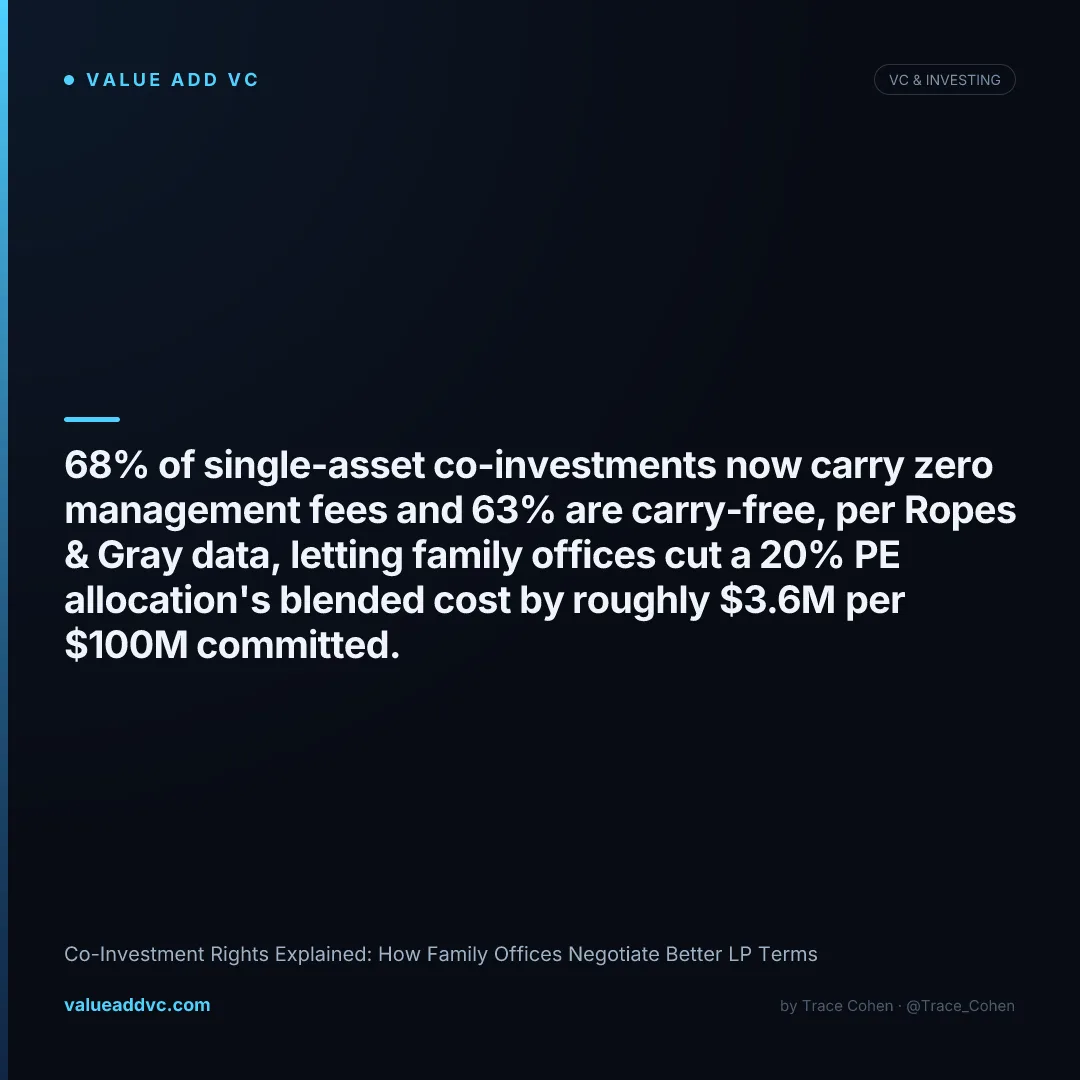
A 20% co-investment allocation on a $100M private equity program saves roughly $3.6M in fees and carry over the fund's life, and 68% of single-asset co-investments now charge zero management fee at all. That's the short answer. The longer answer is how you actually get those rights written into your LP agreement.
Co-investment funds raised $47.3 billion in 2025 — the highest annual total on record, per PitchBook's Q1 2026 Global Private Market Fundraising Report — and family offices are a disproportionate share of that capital. But the direct, deal-by-deal co-investment rights that make headlines for saving LPs millions in fees aren't handed out automatically. They're negotiated, usually before the fund even closes, and the terms of that negotiation determine whether a co-invest program becomes a fee-saving edge or a concentration risk that blows up a portfolio.
Figures from PitchBook's Q1 2026 Global Private Market Fundraising Report, Ropes & Gray single-asset co-investment data (2022-2026), BlackRock private markets analysis, and industry LP surveys cited in 2026 reporting.
What Are Co-Investment Rights and How Do Family Offices Negotiate Them?
Co-investment rights are contractual permissions, documented in the fund's Limited Partnership Agreement (LPA) or a bilateral side letter, that let an LP invest directly in a specific portfolio company alongside the main fund's capital — on top of, not instead of, their regular fund commitment. Family offices negotiate these rights primarily through commitment size and relationship leverage: larger checks, anchor-investor status, or a multi-fund track record with the same GP typically unlock broader or earlier co-invest access than a first-time, smaller LP gets.
The mechanics matter as much as the headline right. A well-negotiated co-investment clause specifies four things: the allocation methodology (pro-rata across all eligible LPs, or discretionary at the GP's choice), the notification timeline (how many business days an LP gets to decide once a deal is offered), the fee terms for the co-invest vehicle specifically, and any conflicts-of-interest disclosure the GP owes co-investors. According to ILPA Principles 3.0, best-practice LPAs spell out all four explicitly rather than leaving them to GP discretion after the fact — and family offices that skip this step during fund negotiation often find their "co-investment right" is functionally unenforceable when a hot deal actually comes along.
"Blind-pool fund commits are out, deal-by-deal co-invest pipelines are in" is how the trend was described in April 2026 industry commentary, and it reflects a real shift in LP preference: family offices increasingly want to see and choose specific deals rather than write a blank check to a GP's full strategy. That preference is exactly why co-investment rights have become one of the most contested terms in fund negotiations over the past two years.
The Fee Math: Why Co-Investment Rights Are Worth Negotiating Hard For
The economic case for co-investment rights comes down to fee compression. Standard fund terms run roughly 2% management fee and 20% carried interest — the "2 and 20" model. Co-investments, by contrast, routinely charge far less: Ropes & Gray's dataset on single-asset co-investments from 2022 forward found 68% charged zero management fee and 63% were entirely carry-free, with 49% of deals over the trailing three years carrying neither fee nor carry in any form. When fees are charged at all on a co-invest vehicle, they typically run 0.75% to 1% management and 7.5% to 15% carry — roughly half of standard fund terms.
| Co-Invest Allocation | Blended Fee/Carry | Est. Savings ($100M program) | Notes |
|---|---|---|---|
| 0% (standard fund only) | 2.0% / 20% | $0 (baseline) | Full primary fund fee load |
| 10% | ~1.8% / 18% | ~$1.8M | Modest co-invest sleeve |
| 20% | ~1.6% / 16% | ~$3.6M | BlackRock reference case |
| 30% | ~1.5% / 15% | ~$5.0M est. | Requires strong GP relationship |
| 40% | ~1.4% / 14% | ~$6.0M+ | ~30% compression vs. standard 2/20 |
| Single-asset, no-fee deal | 0% / 0% | Full fee avoidance on that deal | 68% of 2022+ single-asset co-invests |
Figures are 2026 estimates blended from BlackRock private markets analysis and Ropes & Gray single-asset co-investment fee data. Savings figures assume a $100M private equity program held over a typical 8-10 year fund life; actual terms vary by GP and vintage.
How Family Offices Negotiate Better LP Terms on Co-Investment Rights
Negotiating leverage for co-investment rights comes almost entirely from what a family office brings to the fund at closing. Anchor LPs — typically the first or largest checks into a new fund — get the broadest co-invest terms because GPs need their commitment to hit a first close. Mid-sized, repeat LPs earn expanded rights over multiple fund vintages as trust builds; a family office on its third fund with the same GP will almost always get better co-invest terms than a first-time investor writing an identical check size. Smaller or newer LPs frequently get pro-rata co-invest access only after several cycles of demonstrated reliability — showing up for capital calls on time, not creating friction in the LPAC, and adding strategic value beyond the check.
Some GPs offer co-investment rights to all fund LPs pro rata, distributing deal access evenly regardless of check size. Others reserve co-invest opportunities for anchor investors or LPs providing additional strategic value — board expertise, operating relationships, or follow-on capital certainty. Family offices should ask directly, during fund diligence and before wiring a commitment, which model a GP uses; this single question often reveals more about actual co-invest access than the LPA's boilerplate co-investment clause.
Governance terms matter beyond allocation and fees. Family offices rarely retain the right to hold a co-investment position past the GP's chosen exit — a real drawback for investors who are structurally built for multi-generational, patient capital rather than a fund's typical 5-8 year hold. Side letters should also address information rights (what reporting a co-investor gets versus a primary LP) and expense allocation (who pays broken-deal costs if diligence on a co-invest opportunity falls through). Our VC Performance dashboard tracks which GPs are actively offering co-invest programs to their LP base, which is a useful diligence input before a family office commits to a new fund relationship.
The Risks: Concentration, Compressed Diligence, and Exit Control
The savings math on co-investment rights is real, but so are the risks, and they concentrate around three issues. First, position sizing — a single co-investment can represent 5-10x the exposure of a typical fund-level position in one company, which means a co-invest program that looks like smart fee management on paper can quietly turn a diversified fund portfolio into a handful of concentrated single-name bets. Second, compressed due diligence — co-invest decisions typically require a family office to move in 2-4 weeks from GP notification to a funding decision, a fraction of the diligence window a primary fund commitment gets, which pressures even well-resourced family offices to rely heavily on the GP's own underwriting rather than independent analysis.
Third, exit control — family offices co-investing alongside a GP almost never have the contractual right to block or delay an exit, even when the GP is selling into a market the family office believes undervalues the asset. This is the single most common source of post-close friction in co-invest relationships, and it's worth negotiating explicit language around drag-along rights and minimum hold expectations before capital moves, not after.
Co-Investment Rights vs. GP Co-Invest: Don't Confuse the Two
One recurring source of confusion: LP co-investment rights and GP co-invest both use the word "co-invest," but they describe entirely different capital and entirely different negotiating dynamics. LP co-investment rights, the subject of this piece, let an outside limited partner — a family office, in most of the cases discussed here — put capital directly into a specific deal alongside the fund. GP co-invest refers to the general partner's own commitment into their own fund, a mechanism institutional LPs use to test alignment of interest.
Historically, GP co-invest ran 1-3% of total fund commitments. The 2026 trend is pushing that upper bound toward 3-5% as institutional LPs press GPs harder on skin-in-the-game, especially at first-time and emerging manager funds where track record alone can't establish trust. Family offices evaluating a new GP relationship should ask about both numbers — the GP's own co-invest percentage and the LP co-investment rights on offer — since a GP with low personal co-invest and generous LP co-invest terms may be using investor capital to source deals it isn't fully convicted on itself.
Bottom line: Co-investment rights are worth negotiating hard for — 68% of single-asset deals now come fee-free, and a well-structured 20% co-invest allocation can save $3.6M on a $100M program. But the rights only pay off if the LPA or side letter nails down allocation methodology, notification timelines, and exit governance before the first deal is offered. Family offices that negotiate these terms upfront turn co-investing into a genuine fee-saving edge; those that don't often discover their "right" was more theoretical than real when the first hot deal actually shows up.
Latest from the Pulse
Get VC data most people never see
— free to subscribe
Trace's notes on venture, AI and startups, a few times a week. Join 5,000+ subscribers. No spam.