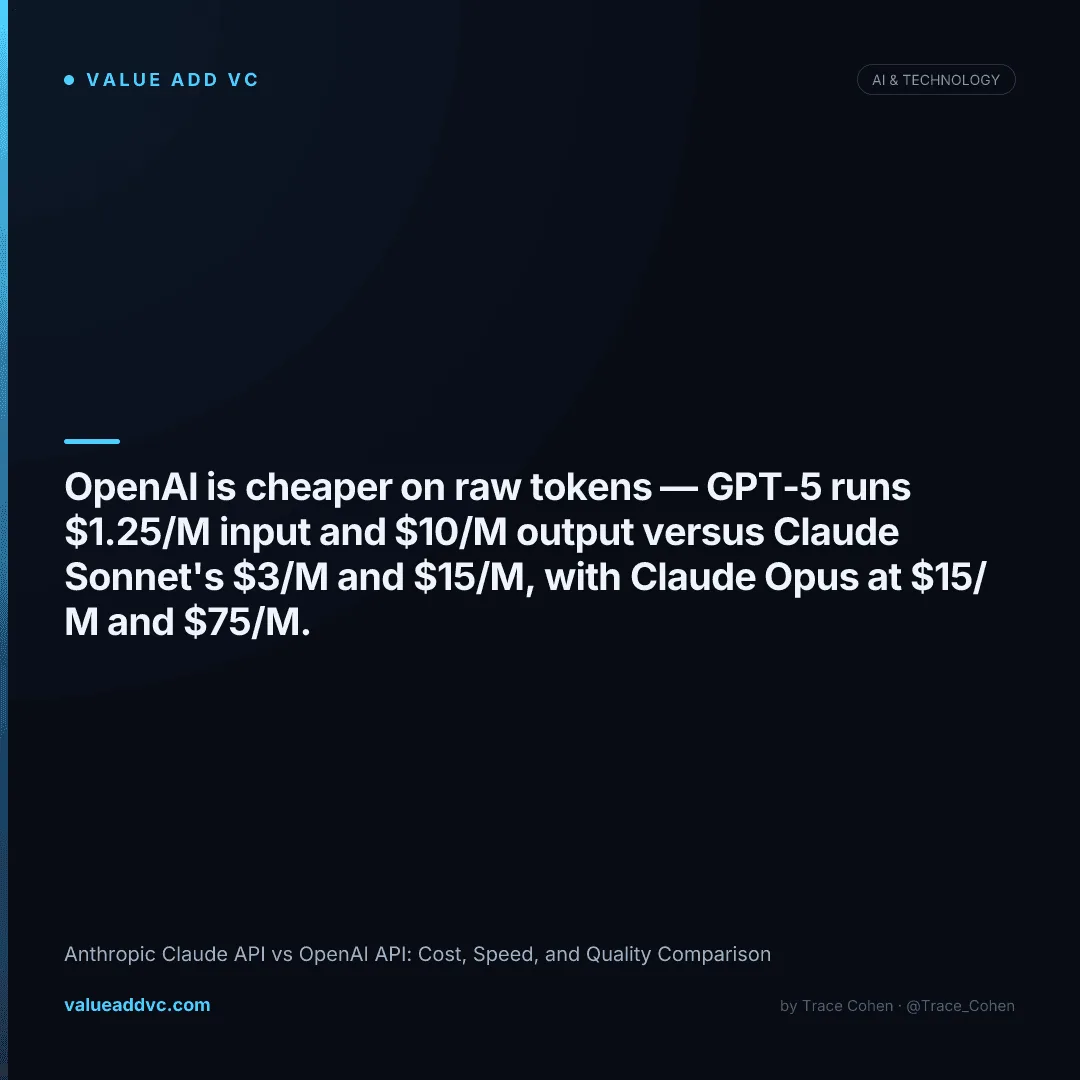
OpenAI wins on price — GPT-5 is $1.25 per million input tokens vs Claude Sonnet's $3 — but Claude wins on coding and complex reasoning, scoring ~77% on SWE-bench Verified against GPT-5's ~72%. Which of those advantages actually matters depends on what you're building.
I've shipped products on both APIs and watched 65+ portfolio companies make this call. The mistake almost everyone makes is treating it as one decision. It isn't. You should be choosing a model per workload — and most serious teams end up running both behind a router.
Anthropic vs OpenAI API cost comparison: the numbers
On the Anthropic vs OpenAI API cost comparison, OpenAI is cheaper per token at every tier. GPT-5 lists at $1.25 per million input tokens and $10 per million output tokens; Claude Sonnet is $3 and $15; Claude Opus is $15 and $75. But token price is not your bill — caching, retries, and output verbosity move real costs by 2-3x, which is why the cheapest sticker price rarely wins in production.
| Model | Provider | Input /M | Output /M | Context | Best at |
|---|---|---|---|---|---|
| Claude Opus | Anthropic | $15 | $75 | 200K | Agents, hard reasoning |
| Claude Sonnet | Anthropic | $3 | $15 | 200K–1M | Coding, long docs |
| Claude Haiku | Anthropic | $0.80 | $4 | 200K | Fast, cheap tasks |
| GPT-5 | OpenAI | $1.25 | $10 | 400K | General, multimodal |
| GPT-5 mini | OpenAI | $0.25 | $2 | 400K | High-volume chat |
| GPT-5 nano | OpenAI | $0.05 | $0.40 | 400K | Classification at scale |
Prices reflect standard published API rates as of mid-2026 and exclude batch (typically 50% off) and prompt-caching discounts. Anthropic caches reads at up to 90% off; OpenAI offers automatic caching at roughly 50-75% off repeated prefixes.
Where the real cost lives
A 12x sticker-price gap between Claude Opus and GPT-5 sounds decisive until you look at total cost of a completed task. Three factors quietly dominate the bill:
Retries
A model that gets a coding task right on the first pass is cheaper than one at 1/3 the token price that needs three attempts and human review. Claude's lower retry rate on agents narrows the gap.
Output verbosity
Output tokens cost 4-8x input. GPT-5 tends to be terser by default; Claude can be steered terse with system prompts. Verbosity differences of 30-40% swing real cost more than list price.
Caching
If 80% of your prompt is a fixed system context, Anthropic's 90%-off cached reads can make Sonnet cheaper per call than GPT-5 with no caching configured.
Claude API vs OpenAI API on quality and speed
On the Claude API vs OpenAI API quality question, the split is consistent across 2026 benchmarks: Claude leads on agentic coding and long-context reasoning, GPT-5 leads on raw speed, math, and multimodal breadth. Here is how they line up on the metrics that actually predict production behavior.
| Dimension | Claude (Sonnet/Opus) | OpenAI (GPT-5) | Edge |
|---|---|---|---|
| SWE-bench Verified | ~77% | ~72% | Claude |
| Tokens/sec (typical) | 60–90 | 80–110 | OpenAI |
| Time-to-first-token | Higher | Lower | OpenAI |
| Max context window | 200K–1M | 400K | Claude |
| Long-doc reasoning | Stronger | Strong | Claude |
| Multimodal (image/audio) | Image only | Image+audio+more | OpenAI |
| Math/competition | Strong | Stronger | OpenAI |
| Instruction adherence | Stronger | Strong | Claude |
Benchmark figures are approximate and shift with model updates. Run your own evals on your actual prompts — public benchmarks rarely match your workload distribution.
Which API to ship on, by workload
The Anthropic vs OpenAI API cost comparison only matters once you fix the workload. Here is the routing logic I actually recommend to founders:
Ship Claude
- ✓ Coding agents and large-codebase refactors
- ✓ Multi-step tool-use agents where errors compound
- ✓ Long-document analysis (contracts, filings, research)
- ✓ Tasks where instruction-following must be exact
- ✓ Workflows with big cached system prompts
Ship OpenAI
- ✓ High-volume consumer chat at low cost
- ✓ Latency-sensitive autocomplete and suggestions
- ✓ Classification and extraction at massive scale (nano)
- ✓ Audio and richer multimodal pipelines
- ✓ Math-heavy or competition-style reasoning
The both-APIs strategy
Nearly every AI company I track at scale runs both providers behind a routing layer. The reasons are boring and correct: failover when one provider has an outage, price arbitrage per request, and the freedom to move a workload the day a new model ships. Building against one vendor's SDK as if it's permanent is the single most common architectural regret I hear from founders.
Practically, that means abstracting your model calls behind a thin interface from day one — whether you use a gateway like OpenRouter, a managed router, or 30 lines of your own code. The cost of switching should be a config change, not a refactor. If you're sizing the broader market behind these models, the AI Valuations dashboard tracks how the foundation-model layer is being priced, and the AI Spending dashboard shows where the infrastructure dollars are flowing.
The verdict
There is no single winner — but if you forced me to pick one for a product I was building today, it would be Claude Sonnet as the default, with GPT-5 mini for cost-sensitive high-volume paths. Claude's coding and agent reliability is worth the token premium for anything where a wrong answer costs more than the tokens, and Sonnet's $3/M is cheap enough that the gap to GPT-5 rarely shows up on the bill. Reserve Opus for the hardest reasoning and GPT-5 for speed and multimodal. For the financial picture behind OpenAI's pricing power, see OpenAI Revenue 2026: $20B ARR and Path to Profitability. The wrong move is picking a side and marrying it.
Stop asking "Claude or OpenAI."
Pick a model per workload, abstract behind a router, and let the bill — not the headline — decide.
Track how AI models and their makers are valued on the AI Valuations Dashboard at Value Add VC. Originally published in the Trace Cohen newsletter.
Latest from the Pulse
Get VC data most people never see
— 100% free
Weekly benchmarks, valuations, and fund data. Join 5,000+ investors. No spam.