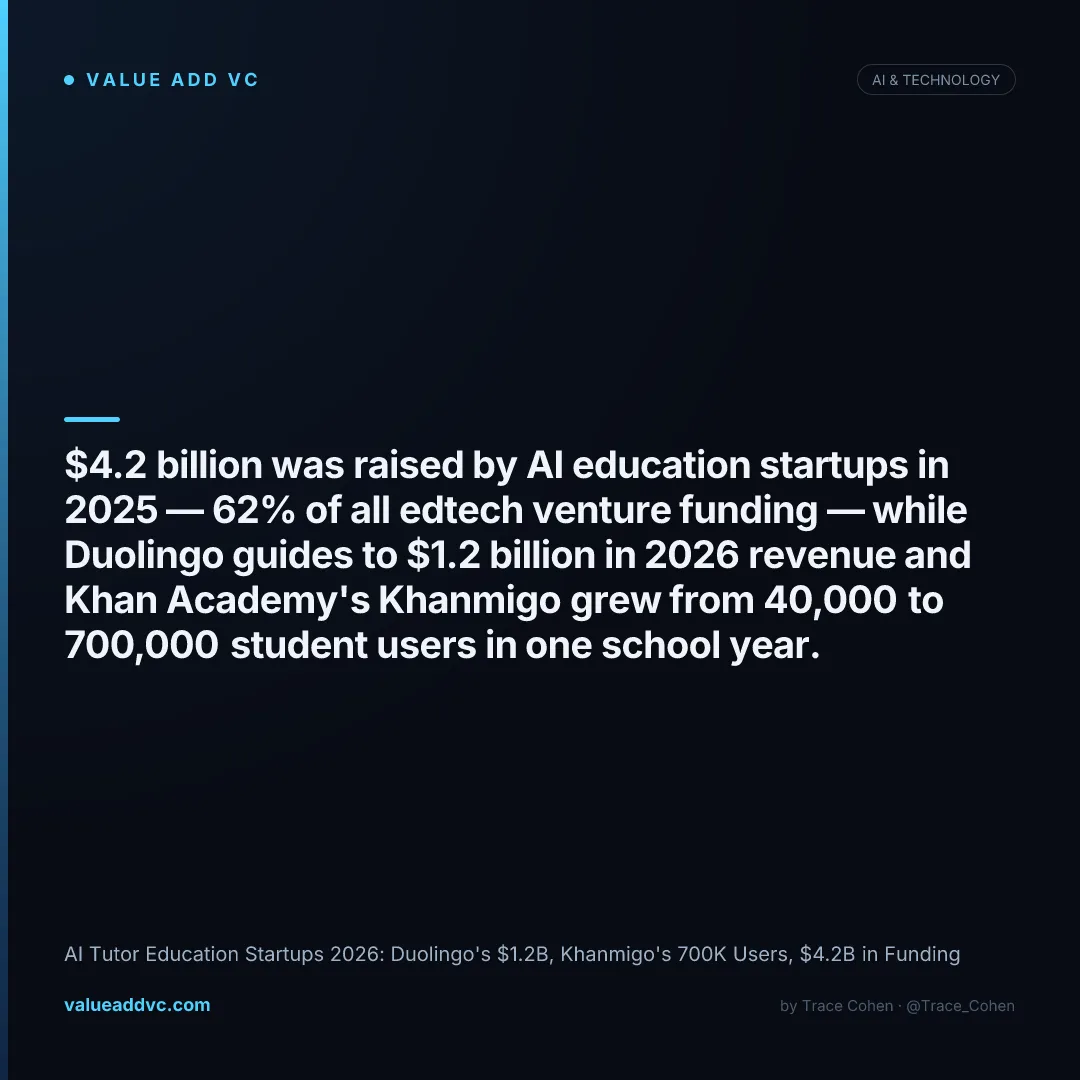
Duolingo is guiding to $1.2 billion in 2026 revenue and Khan Academy's Khanmigo grew from 40,000 to 700,000 student users in a single school year — but only 15% of students with Khanmigo access actually use it regularly. Those two numbers together mean AI tutoring in 2026 has an adoption problem, not a technology problem.
I've looked at a half-dozen AI education pitches this year, and every deck leads with the same slide: a personalized tutor for every kid on earth. The technology increasingly backs that up. What the pitches skip is the messier reality — access and usage are two very different numbers, and right now the gap between them is where most of the real risk in this category lives.
AI Tutor Education Startups in 2026: Who's Actually Building the Category
More than 2,800 AI education startups are operating in 2026 — an 18x increase from 2023 — and they collectively raised $4.2 billion in venture capital in 2025, which was 62% of all edtech funding for the year. Two products dominate the AI-tutor conversation specifically: Duolingo, a public company reorienting its language app around AI-generated content and a new math tutor, and Khan Academy's Khanmigo, a nonprofit-backed AI tutor now deployed across hundreds of U.S. school districts.
| Metric | Duolingo | Khan Academy / Khanmigo |
|---|---|---|
| Business model | For-profit, publicly traded (NASDAQ: DUOL) | Nonprofit, philanthropy + district licensing |
| 2026 revenue / budget scale | $1.205B revenue guidance | Not disclosed; funded via donors + Khanmigo district fees |
| Q1 2026 growth | Revenue +27% YoY to $292M | Users +17x in one school year (40K to 700K) |
| Paid subscribers / seats | 12.5M paid subscribers, +21% YoY | ~700K active student users, 795 districts reached |
| Engagement | 56.5M daily active users, 137.8M MAU | 269,000 weekday interactions; only 15% regular engagement |
| AI strategy in 2026 | AI-generated courses, Duolingo Math tutor push | Redesign rolling out summer 2026 to fix low engagement |
Figures are 2026 estimates blended from Duolingo Q1 2026 earnings, Khan Academy blog disclosures, EdTech Innovation Hub reporting, and AI for Cause. Khanmigo figures reflect different measurement windows across sources and should be read as directional, not audited.
How Duolingo Turned AI Into a $1.2B Revenue Engine
Duolingo's 2026 guidance of $1.205 billion in revenue follows $1.04 billion in 2025 — real growth, not a rounding change. Q1 2026 revenue hit $292.0 million, up 27% year over year, with paid subscribers climbing 21% to 12.5 million and free cash flow reaching $147.8 million for the quarter. Net new annual recurring revenue grew 61% year over year in 2025, a record for the company.
The AI angle isn't incidental — it's the entire 2026 growth story. Duolingo published 20,500 AI-assisted course units in Q1 2026 alone and rolled out speaking features (Video Call, spoken responses, scenario-based practice) that would have been prohibitively expensive to build with human content teams at that pace. Management's explicit 2026 goal is turning Duolingo Math into a leading standalone tutor app, which is the clearest signal yet that the company sees AI tutoring — not just gamified language drills — as its next growth vector. That mirrors the broader shift we track on the AI Landscape dashboard, where consumer AI products are increasingly monetizing through subscription tutoring rather than ads.
Khanmigo's Growth Curve — and Its Engagement Problem
Khan Academy's Khanmigo is the clearest case study in how fast AI tutor distribution can move once school districts sign on. User counts went from roughly 40,000 in the 2024-25 school year to about 700,000 in 2025-26 — a 17x jump — while partner districts expanded from 45 to more than 380. Some broader counts, which include lower-intensity sign-ups, put total registered users near 2 million across 795 districts as of March 2026, a 731% jump in sign-ups in a single year.
But Khan Academy's own disclosure is the more important number: only 15% of students with Khanmigo access use it regularly, averaging about 269,000 interactions on a typical school-year weekday. That gap between district-level rollout and classroom-level habit is prompting a full product redesign rolling out in summer 2026. Between October 2025 and April 2026, Khan Academy ran rigorous product tests and squeezed out a 6.1% improvement in next-item correctness — real progress on the model, but a reminder that the harder problem in AI tutoring is behavioral, not algorithmic.
Where the $4.2B in AI Education Funding Is Actually Going
AI-focused education companies raised $4.2 billion in venture capital during 2025, representing 62% of all edtech funding for the year — a striking concentration for a subsector that barely existed as a distinct funding category three years ago. AI tutors and educator copilot tools together captured nearly 85% of that capital, dwarfing everything else in the edtech stack.
The teacher-facing side of the market is smaller in dollar terms but growing fast — MagicSchool AI, Brisk Teaching, Curipod, Teacher's Buddy, and Chalkie collectively raised over $90 million in recent rounds, and seed-stage deals like Vimi, Giant, and Pensive each closed $7-12 million rounds in early 2026, a sharp valuation reset upward from just 18 months prior. Separately, a narrower count of 26 verified K-12 and higher-ed pure-play funding rounds between Q1 2025 and Q1 2026 totaled roughly $229 million, illustrating how much of the headline $4.2 billion is concentrated in a handful of large, later-stage checks rather than spread across the broader startup count.
How Big Is the AI Tutoring Market Actually Going to Get?
Estimates diverge sharply depending on methodology, which is itself worth flagging before anyone builds a model off a single number. Grand View Research puts the global AI tutors market at $2.11 billion in 2025, projected to reach $17.72 billion by 2033 at a 30.5% CAGR. A narrower estimate from a different research house puts 2025 at $3.55 billion, growing to $6.45 billion by 2030 — a much more conservative CAGR in the high teens.
For investors tracking where this shows up in valuations, the AI tutoring category behaves less like traditional edtech (3-6x revenue multiples historically) and more like frontier consumer AI, where usage growth and engagement depth — not just top-line ARR — determine whether a company clears a 10x+ multiple. That's the same dynamic playing out across the broader AI sector on our AI Valuations dashboard.
Beyond Duolingo and Khan Academy: Who Else to Watch
Duolingo and Khanmigo get the headlines because they have the user counts, but the more interesting early-stage activity in 2026 is happening one layer down, on the teacher-facing side. MagicSchool AI, Brisk Teaching, and Curipod have collectively raised over $90 million by building AI directly into lesson planning, grading, and classroom workflow — tools teachers open every day regardless of whether the district has formally rolled out an AI tutoring initiative. That workflow-embedded distribution is a meaningfully different bet than a student-facing tutor competing for a teenager's attention against everything else on a phone.
At the seed stage, Vimi, Giant, and Pensive each closed $7-12 million rounds in early 2026, and the fact that seed valuations in AI education have reset sharply upward compared to 18 months prior tells you where investor conviction is heading even before usage data catches up. The honest read for anyone underwriting this category: teacher-copilot tools have an easier path to habitual use because they slot into an existing job, while pure AI-tutor products — no matter how good the underlying model — have to win the much harder fight for a student's discretionary time. Khan Academy's 15% engagement number is the clearest evidence yet of how hard that second fight actually is.
What This Means for Investors Looking at AI Tutor Education Startups
The lesson from both Duolingo and Khanmigo is the same: distribution is no longer the hard part of AI tutoring. Duolingo already has 137.8 million monthly active users, and Khan Academy can put a product in front of 380+ school districts in a single year. The hard part — the part every founder pitching an AI tutor needs a real answer for — is converting access into a daily habit. Khan Academy's own 15% engagement rate on Khanmigo, despite a philanthropic budget and a trusted brand, is the best evidence in the market that habit formation in AI tutoring doesn't come for free just because the underlying model is good.
For early-stage checks, that reframes diligence: weekly-active-to-total-access ratio matters more than logo count, and teacher-facing tools like MagicSchool AI and Brisk Teaching — which insert AI into an existing daily workflow rather than asking for a new one — may have an easier engagement path than pure student-facing tutors, even if the total addressable market looks smaller on paper. Track how this category compares to the rest of the AI funding landscape on the AI Landscape dashboard and the Unicorn Tracker.
The Bottom Line
AI tutoring in 2026 has real revenue (Duolingo's $1.2 billion guidance), real distribution (Khanmigo's 700,000 users and 380+ districts), and real capital ($4.2 billion raised in 2025 alone). What it doesn't have yet is proof that access reliably converts into daily use — Khan Academy's own 15% engagement number is the honest data point the rest of the sector should be benchmarking against, not the sign-up growth charts everyone leads with.
$4.2 billion raised. 700,000 Khanmigo users. Only 15% using it regularly.
Distribution is solved. Engagement is the entire game now.
Track AI company valuations, funding, and the broader AI landscape on the AI Valuations Dashboard and AI Landscape Dashboard at Value Add VC. Originally published in the Trace Cohen newsletter.
Latest from the Pulse
Get VC data most people never see
— free to subscribe
Trace's notes on venture, AI and startups, a few times a week. Join 5,000+ subscribers. No spam.